Thursday, June 28, 2012

False Negative (Joseph Koenig, 2012)

I often bitch about how some books are not “crime” enough, and with this one, I certainly got a big dosage of it! We follow this guy, Adam Jordan, who is a crime reporter and fucks up one job big time, but also big time funny and even educational: “Professor Einstein could learn a thing or two from Adam Jordan. It was not impossible to be in two places at the same time, if no one checked.”  Anyways, he then becomes a writer because “we pay better since good crime writers are harder to find than inventive killers.” In one of the numerous sub-plots his editor gets killed so eventually he takes over managing of Real Detective magazine. So, you see, everything is related to crime one way or another so I really cannot complain about it on this occasion.

There is, of course, one main plot, although we are never sure if others are connected. It starts with Jordan finding a beautiful, dead girl on the beach. At first, he’s not too interested, but later, he needs a story for his editor and starts digging into the case. Needles to say that deeper he digs more dirt comes out in the open. And more corpses of (mostly) beautiful women. 

Nothing and nobody is simply black and white here. Everything is gray and in pretty fucking dark shades of gray I might add. That includes our hero who is likeable but nevertheless opportunistic bastard who lives off other people’s misfortunes. We have sleazy photographer, beauty pageant queens with price tags all over them, incredibly cynical (and hysterically funny) editor, hookers, pimps, mobsters etc. Even the only good person freely admits she'll do what it takes to meet the right people. There’s a nice touch at the end when the murderer stoically replies to Jordan that he’s no better or worse than him, as they are all just predators and vultures. I’m sure Raymond Chandler was smiling approvingly when reading this in heaven.

But as brilliant as the story is and colourful as the characters are, for me, the sheer genius of this masterpiece lies in its style. I was amazed to learn that it was published only recently for the first time because the language used and overall atmosphere are totally good-old hard-boiled times. City, of course, is an asphalt jungle, cops are dirty, there’s still racial segregation, and there's lots of jazz. Our hero is a fan and he frequently visits gigs of Charlie Parker, Billie Holiday, Mingus and others. Louis Armstrong himself even appears in one of the subplots! 

Joseph Koenig is now on my radar.

5/5

Facts:

Hero: 
Adam Jordan, ex-reporter turned pulp writer and editor.

Location: 
1953, Atlantic City for most time, and shortly in New York

Body count: 
7 most likely 8, although 2 are not directly related to the main story

Dames: 
Next Miss America and black (kind of) hooker

Cover: 
Good and pretty accurate. The photographer is an important character of the story, and he does shoot girls nude. I like her facial expression because she’s a bit frightened and not lustful of flirtatious as she’s supposed to. Illustrated by Max Phillips, who is a regular artist of Hard Case Crime books, and I think this one, together with Ed McBain’s The Gutter and the Grave, is his best.

Cool lines:
Don’t bother about the suspect, if she’s the dog you say she is. Describe her as being unconventionally beautiful. 

Like most mid-size east coast dailies the Press gave little ink to Negroes. Sure, Negro criminals preying on whites made for good copy. But if you played out the disappearance of a Negro girl, you would be expected to cover her friends’ weddings, and the birth of their children, and to make space on the obituary page, too. The readers did not want integration with their morning coffee. 


She felt tears welling, but wouldn’t let them come. They were a part of herself she was able to keep him from having.

    Tuesday, June 26, 2012

    The Last Quarry (Max Allan Collins, 2006)

    To be honest, this is not very good. In the afterword, Collins mentions he wrote it as a kind of favour to Hard Case Crime‘s editor Charles Ardai after he had promised him Robert McGinnis for a cover illustration. But I think he simply had nothing to do so out of boredom decided to bring alive his most famous hero.

    It does start promising. We get to refresh our knowledge of Quarry’s story and his current situation. Which is not a very exciting one because he is employed as the keeper of a holiday resort. And since it’s off-season time, the inn is empty, and the only thing Quarry needs to fight is insomnia. That quickly changes when he accidentally gets involved in the kidnapping of some rich brat. And so by the end of the fifth chapter, we have two dead kidnappers and one free rich brat. And Quarry gets a contract by her ass-hole rich father.

    So far, so good. The stage is now set for some real action. Unfortunately, we will have to wait quite a while to get some. Because instead of shifting into higher gear, everything just falls flat. The story doesn’t move anywhere, no new characters or subplots are introduced, and we must basically endure the process of Quarry’s falling (you know – in a romantic kind of way) for his target. It’s pathetic and almost embarrassing at times. Looks like Mr Collins had a similar opinion, so he just finished everything quickly with some ridiculous shoot-out massacre and “surprising” twist.

    The writing is poor, likely intentionally, to give it a more pulpy feel. Its strong points are witty dialogues, but there are just too many unnecessary “fucks” and moronic machismo-isms about women (plus some mandatory gay “jokes”), sex and violence. Latter is especially cartoonish: he beats some bad ass marine guy like he’s a fucking kid, and in the already mentioned shoot-out, the bad guys are disposed of as easily as clay pigeons:
    1. The guy took it in his head
    2. With the headstone as a cover, I took out the two closest ones
    3. I took the nearest to me when he slipped his head out to take aim
    4. He had almost made it to cover when my shot caught him in the side of the head
    5. He, too, took a bullet in the head and fell backward
     See what I mean? No wonder they were such great pals with Spillane.

    I expected more after reading Quarry in the Middle. It’s probably perfect reading when you’re on the plane and you hardly need to concentrate. So here’s a good tip for your next travel: it will make waiting in queues easier, and you won’t pay much attention to turbulence.

    2/5

    Facts:

    Hero: 
    Hitman Quarry. But for the purposes of this narrative, however, we’ll say my real name is Jack Keller.

    Location: 
    Hard to tell. Again, Quarry is quite secretive, keeping his identity hidden. But he does drop us a hint: “Sylvan Lake, somewhere in Minnesota, only it’s not called Sylvan Lake and maybe it’s not Minnesota, either.” So go figure! Action then moves to a small city named Homewood, which I managed to locate on Google Maps – it’s 30 miles south of Chicago. 

    And the year is most probably 2005 because “Janet was still advertising Kerry/Edwards 2004” with her car’s bumper stickers.

    Body count: 
    2………no, nothing …………still nothing (2 fucks though)………… one more fuck ………… 1+1….. 6+1 = grand total of 11 (+ 3 fucks)

    Dames: 
    Janet, the librarian and her sister Julie

    Cover: 
    Pretty accurate. On two occasions, he peeks at the girl through the window, but he wears a beard (shaved off later, so maybe that confused the artist). The second time, he doesn't have a gun, but a girl actually wears a “pinkish excuse for a bra”. Illustrated by famous Robert McGinnis but this one I think was also made quickly and without much paying attention to the details. Let’s say it’s okay but not great.

    Cool lines:
    He answered with another question: “Do you have any reservations about taking out a woman?”
    “I take women out all the time.”
    “Not the way I mean.”
    I smiled just a little. “Are you sure?”

    “Julie has a potential. She has fire. Spirit. She’s just … going through a phase.”
    I nodded toward the hole in the ground. “So is your other daughter – it’s called a decomposition.

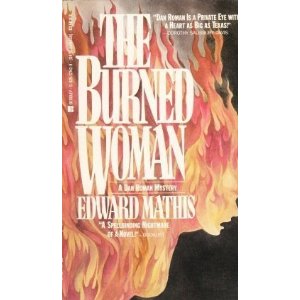
    The Burned Woman (Edward Mathis, 1989)

    This one is as full of clichés as they come:
    - We have this ex-policeman turned PI
    - He drinks too much
    - His best friend is a policeman who also used to be his mentor
    - Big ass politician/businessman is involved
    - Big ass rock star is involved
    - We have a hooker with a golden heart
    - And deviant sex hinting at incest
    It starts decently with the disappearance of our hero’s wife in strange circumstances that include a highway accident in which a young woman is burned to death. So he goes into overdrive and starts an investigation. And since he earns his living by being a fuckin’ PI, one would expect this investigation to be efficient and quick, resulting in the recovery of his better half. Especially because he has the support and resources of the local police department behind him. 

    Mistake! It drags on and on and is basically reduced to interviewing people connected to the victim, although there’s no apparent connection between the two events. So after three weeks (!?!!), he basically gives up and starts drinking even heavier and even fucking some young prostitute. What an asshole, he didn’t need much time to forget his beloved one! 

    But then, suddenly, out of the blue, he gets an idea or clue he missed and cracks the case. Happy end, and they lived happily ever after.

    I guess this book could be okay if everything moved at a quicker pace and wrapped up after a few days. But all that drama is unnecessary, especially since no significant leads are found and no events related to the case occur. FBI seems to come in just to show (a) how incompetent but still tough they are and (b) to have one of the agents fuck that poor hooker to show (I guess) how vulnerable and generally fucked up she is. Total ballast. Also, the language could be less monotone and the dialogue sharper.

    All in all, routine and forgettable stuff.

    2/5

    Facts:

    Hero: 
    Dan Roman, Vietnam vet, ex-cop, now PI

    Location: 
    Around Fort Worth near Dallas, Texas. Present time.

    Body count:
    3

    Dames: 
    Susie, the kidnapped wife. 
    Charlotte “Charley” Wilkins, the victim. 
    Alicia, Charley's roommate.

    Cover: 
    Pretty cool, and it matches the title because there's an illustration of a woman’s face and upper body emerging from the fire. A bit arty and a bit comic book style. There’s no info about the author.

    Cool lines:
    “He’s pretty big star,” she said, as if that explained everything. “So’s the sun, but I don’t want it crashing into my house at three o’clock in the morning.”

    He saw it a fraction of a second before I pulled the trigger: he had time to grunt again, widen his eyes, maybe time to know he was going to die.

    Monday, June 11, 2012

    Nobody’s Angel (Jack Clark, 1996)

    I was little misled by the cover which said author was Shamus Award finalist. Jack Clarke, of course, was a nominee, but not for this novel. And it would be highly unlikely to be nominated for anything related to the crime for this book. It’s well written and has an unusual concept, but it’s just not a crime novel. I was puzzled about why Hard Case published this in the first place and found the answer on their website:

    Nobody’s Angel, the author's first novel, was originally self-published in an edition of only 500 copies that the author sold for five dollars apiece to passengers in the Chicago taxi he drove for a living. Hard Case Crime is proud to give the book its first professional publication.

    So I guess his breakthrough novel, titled Westerfield’s Chain, must have impressed editors so much that they decided to publish this one. Which is intriguing, and I’m putting it on my to-do list.

    But anyway, if this is not a crime, mystery, thriller, espionage, etc., then what the hell is it? It’s basically about taxi driver Edwin Miles, whose friend gets killed, so Eddie spends the following 200+ pages driving around Chicago, describing the city’s (and his own) sad history and layout of its streets, and (of course) picking up passengers. At first it is somehow interesting and even amusing and I quite enjoyed it but then approximately halfway through I realized that this was all I was going to get. Because this guy has no system or technique or methodology, and it became clear that crime will be solved by him eventually (after 25 fares!), picking up the killer.

    So it’s not very good, but at the same time, it’s not bad at all. It's not too boring because there is another violent crime (so we have two serial killers!), some interesting characters are introduced (cops and other taxi drivers and maybe his fuck buddy, although stuff about his ex-wife and kid is totally redundant), and a few of the adventures with his colourful passengers are also quite good. 

    Well worth mentioning are chapter openings, which cite official regulations from Chicago’s Department of Public Vehicle Operations. They give you a hint about what will follow and are (of course) written in this crazy bureaucratic language, and some of them are hilarious. Like “…Wherever used in these rules, the use of the masculine gender includes the feminine gender; the singular includes the plural and the plural the singular.” 

    It’s interesting and original stuff, obviously written from experience and also from the heart, and I would recommend it to anyone who lives in Chicago or plans to visit. To me, those endless descriptions of areas and street listings were just too repetitive and simply annoying towards the end. Felt like reading fucking Lonely Planet.

    2.5/5

    Facts:

    Hero: 
    Eddie Miles, taxi driver

    Location: 
    Chicago

    Body count: 
    1

    Taxi fares count: 
    26

    Dames: 
    None really, maybe the victim, a hooker. Because he’s not her angel, he’s nobody’s angel.  

    Cool lines:
    “You know what a taxi rolling through the ghetto is?” I asked. “What’s that?” “An ATM on wheels.”

    I looked back in the mirror. They were both watching me, phony smiles planted on their faces. She was a very old twenty-five. They were both hard looking, cheap white trash.

    “It’s okay,” I said. “I’ve got some money in the bank.” “Christ,” he said. “Never tell a lawyer that.”

    Thursday, May 31, 2012

    Night Walker (Donald Hamilton, 1954)

    The first 90% of this book is simply brilliant and a reason why I go through so many shitty and mediocre pulps. It’s all worth it in the end to read such quality stuff. The story is pretty simple, and we’ve heard it many times before. We have this mistaken-identity man without a face, with a shady past, who gets involved in some sinister happening alongside this strange femme fatale.

    What I loved about it is that our hero basically has no influence whatsoever on events and actions. He just sits tight (or lies injured in the bed) in this big old mansion house, totally puzzled and powerless to control the situation. His instincts keep telling him he’s being fucked, and his “partner in crime” dame is lying and misleading him and destroying evidence all the time, but for some reason, he just doesn’t pack his stuff and leave. And in the meantime, the plot is progressing as we are introduced to a few pretty colourful characters (the victim’s young friend/possible lover, her eccentric aunt, the local doctor with secret/strange motives) and some sinister background involving international espionage. The end of the story is somewhat disappointing, but more about that later.

    Our main protagonist is cool, but Carol definitely steals the show from him, and I cannot remember the last time I encountered such a cool femme fatale. I would like to think that the author himself liked her a lot, because the descriptions of her are much better and more detailed than those of the other characters. Just loved those southern “I declare”! And she is 'fatale' all right – the only constant thing about her is that she’s constantly lying. A cool thing is that our hero also knows that, and here is a short outline about their relationship’s progression:
    1.  Her voice was sweet and wholly insincere, yet her nearness was pleasant and reassuring. He said, “Elizabeth, you’re a fraud. If I went near that phone, you’d probably shoot me.”
    2. He wanted very much to trust her but knew that he couldn’t afford to. Theirs was not a relationship built upon trust and respect but simply upon loneliness and mutual need.
    3. Neither of them had said anything; there had been nothing to say. Her whole story had been a fabric of deceit.
    4. He did not look at her. He knew her well enough now that he did not even have to see her face to know when she was lying, although her reasons were not always clear.
    5. He found that he was thinking of her very much in the way he might have thought of a girl who had contracted a disease from which she was not expected to recover.
    Marvellous, isn’t it?! Writing is superb anyhow and has this really claustrophobic feeling to it. The story starts in the car, then moves to a hospital for a short time, then takes place for the most part in a secluded house, and finally ends on the boat. And our main protagonist has his face covered in bandages, which also emphasises confinement. Simply brilliant, it reads like a play, and I’ve enjoyed every minute of it.

    As I said, the ending is a bit disappointing. Not because it’s bad, it’s just that tension is built so well that you expect some big, surprising twist. After all that careful plotting and scheming, it deserves better, a more hard-boiled climax with a shocking revelation, but instead it settles for a rather ordinary espionage thriller conclusion. But I don’t really mind because everything else is perfect!

    4.5/5

    Facts

    Hero: 
    David Young, Navy Lieutenant, 29.

    Location: 
    Place near Bayport, Maryland

    Body count: 
    3 (and it’s pretty cool because number once actually decreases!)

    Dames: 
    Elizabeth Wilson

    Cool lines:
    We’re all real respectable folks, and this is our first kidnapping.

    It was a house that took itself seriously, but the shaggy condition of the grounds gave it an unkempt look, like that of an elderly aristocratic gentleman with alcoholic tendencies.

    The Valley of Fear (Arthur Conan Doyle, 1915)

    Not good at all, I struggled to get through this one. It's divided into two parts: the first is just a classic detective mystery, and the second is truly terrible. 

    It starts with Holmes receiving a ciphered message announcing some terrible crime to be committed. He, of course, easily cracks this code (a pretty obvious one in my opinion), and in no time at all, it also turns out that the dark force behind this “sinister affair” is – once more – none other than Sherlock’s mortal enemy, Dr Moriarty. 

    And here is where I started to dislike the book already. Is there really a need to involve this criminal mastermind in every single crime Holmes investigates?  I’m perfectly okay about him fucking with highly secret state affairs documents, blackmailing politicians, stealing priceless artworks and so on. But come on! I find it hard to believe that in the meantime, he can manage to find time and resources for every single petty crime. But I’m a bit ahead of myself here because at this point in the book, we still don’t know that our crime is/will indeed be petty (spoiler - it is). Another thing about this Moriarty business is that he is simply introduced too early in the story. At this point, there’s absolutely no need for some ominous background; an anonymous tip would do just fine. 

    So now crime has been committed and Holmes, with Dr Watson and the cop (sorry, it’s of course inspector/constable) named MacDonald (nope, no Lestrade in this one), rushes to – surprise, surprise- the English countryside to an old house (ups sorry – it’s actually called a mansion). Here they find the murdered man’s best friend, his wife and – another surprise, you won’t believe this – fucking butler! And beside these people, there’s just one more character - some mysterious and, of course, sinister stranger who has arrived at the nearby village hotel just shortly before the crime and disappeared afterwards. So Holmes has a really hard job on his hands, right? 

    And we follow his unusual methods, witty observations, arrogance and so on to the final shocking conclusion. But it’s hardly some big twist since the dead guy’s face was blown off by the shotgun, and you can smell the change of identity trick right from the start.

    In all honesty, it’s not as bad as it sounds. It is a good old-fashioned Sherlock Holmes mystery, maybe a bit predictable, but still quite enjoyable, although sometimes hard to follow for a non-native English speaker because of all that crappy archaic language. 

    The second part is totally redundant, and I have no idea why it was ever written. It has next to nothing to do with the first one, and it gives the impression that Mr Doyle was being paid by the page. So do yourself a favour and close this book after the first part. You’ll save some time and keep the respect for the old master and his famous detective.

    2/5

    Facts

    Hero: 
    Sherlock Holmes

    Body count: 
    One in the first part, many in the second

    Dames: 
    You kidding? 

    Cover: 
    By Glen Orbik. I liked the colours, but the girl's facial expression could be more terrified.

    Location: 
    The first part starts in London and quickly moves to the English countryside. The second part takes place in some godforsaken mining town in the States.

    The Burglar in the Closet (Lawrence Block, 1978)

    Got this one at the flea market for a couple of Euros. I’m not Block’s biggest fan, but I was totally persuaded by this weird cover. Which, amazingly enough, I cannot find on the internet, so I took a shot of it myself for your viewing pleasure. Its author is a guy named Alan Forster, and after a bit of googling, this could be him.

    Back cover quotes Robert Ludlum saying that this is “Light-hearted crime at its very best”. I’m not sure if this light-hearted crap was an actual category back in those days, but I’m positive that nowadays this novel would end up in the so-called “young adults” section of the bookstore instead of “crime”. It’s not bad, and I’ll probably give it to my nephew when he’s 15, but it’s just not my cup of tea. 

    It’s centred on this amateurish detective whose day job's a burglar. He gets involved in some far-fetched story of burglary/murder mystery involving his dentist (!), and to make things worse, he gets help from another amateur in the dentist’s secretary (!!). And yes, of course, he scores. 

    The main problem is a lack of classical detective work based on logic. Our hero basically cracks the case by getting drunk with a victim's good friend, who supplies him with a list of three men who used to fuck unfortunate Crystal (the victim). They are The Legal Beagle (a lawyer), Grabow the Artist (a painter) and Knobby the Bartender (yes, you’ve guessed it – he’s a bartender), and they become the centre of his investigation and his only suspects (remember Cutie?). He cannot trace one of them, but breaks into the homes of the other two... and, true enough, they are both involved. In the meantime, just to fill in the gaps, I imagine, he must also deal with some good cops, some corrupt cops, and some lawyers (they are all bastards, anyhow). He’s so ridiculously incompetent that he digs himself a hole too deep to get out of, and he even considers hiring a real PI to get him off the hook. I shit you not, here’s a quote: “Maybe I can hire a private detective to investigate this thing professionally. I’m not having much luck as an amateur”. I know, of course, this was meant to be ironic, but to me it’s just pathetic…

    I also had a problem with the writing style, which keeps trying to be amusing and witty. It’s not as annoying as Jonny Porkpie’s (nothing is), but I still struggled to finish this without much yawning. At least it is not very long.

    2/5

    Facts

    Hero: 
    My name is Bernie Rhodenbarr and I’m a thief and I love to steal. I just plain love it.

    Body count: 
    4, all pretty uninspiring. For one of them, it’s not even clear if it was murder, an accident, or maybe even suicide.

    Dames: 
    An ex-wife and a secretary

    Location: 
    NYC, 70s

    Cool lines:
    The problem, of course, derived from an offshoot of Parkinson’s Law. A person, be he bureaucrat or burglar, tends to take for a task as much time as is available for it.